Who this applies to (and who it does not)
The single most common misunderstanding among Dutch founders is conflating two completely different income streams:
-
Operating business profits - the money your LLC earns selling software, consulting, e-commerce, agency services, etc. This is governed by Article 7 (Business Profits), not the dividend article. If your LLC has no US permanent establishment (no US office, no dependent US agent concluding contracts), these profits are not taxable by the US at all - and there is no withholding to reduce. The "0% dividend" headline is irrelevant to this income.
-
US-source passive income - actual dividends from US stocks, interest from US bonds, or royalties from US licensees. This is FDAP income (Fixed, Determinable, Annual, Periodical) and is what the dividend, interest, and royalty articles actually govern.
If you are a freelancer, agency owner, SaaS founder, or e-commerce seller using a Wyoming LLC to invoice US clients, your income is operating profit under Article 7, not dividends. You will almost never use the dividend article. The reason this treaty still matters to you is the combination of Article 7 protection plus the Belastingdienst's clean pass-through treatment - which together produce the "zero US federal tax" outcome that draws Dutch founders to Wyoming in the first place.
The dividend article becomes relevant if you (a) hold US portfolio investments inside the LLC, or (b) build a holding structure where a Dutch BV owns a US C-corporation that pays dividends upstream.
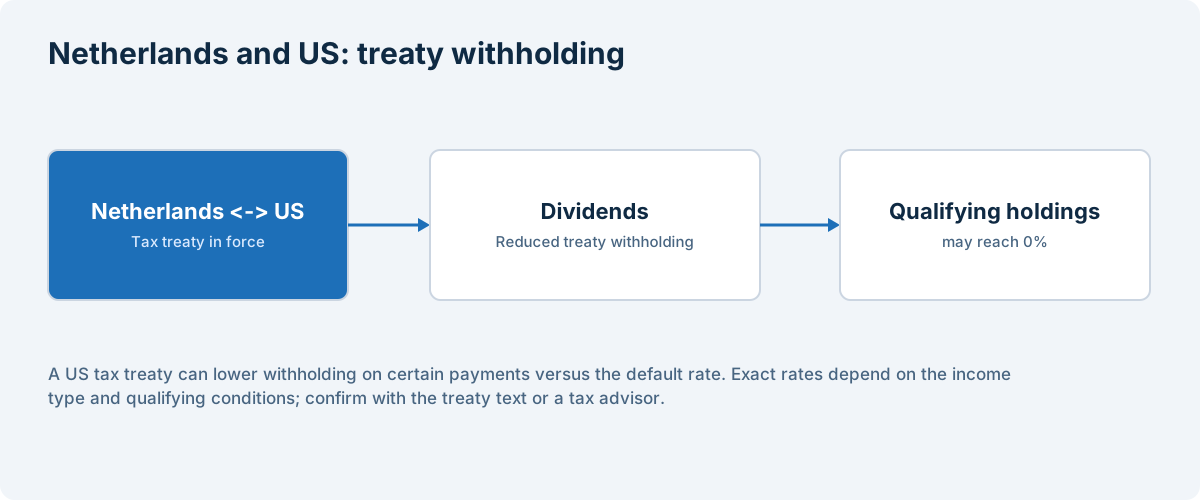
Treaty rates by income type (Dutch residents, 2026)
The table below reflects the treaty as amended by the 8 March 2004 Protocol, which took effect 1 January 2005 and introduced the 0% dividend rate.
| Income type | Default US statutory rate | Netherlands treaty rate | Governing article |
|---|---|---|---|
| Dividends - 80%+ corporate holder, 12+ months | 30% | 0% | Art. 10(3) |
| Dividends - 10%+ corporate ownership | 30% | 5% | Art. 10(2)(a) |
| Dividends - portfolio / standard | 30% | 15% | Art. 10(2)(b) |
| Dividends - qualified Dutch pension fund | 30% | 0% | Art. 10(3) |
| Portfolio interest | 30% | 0% | Art. 11 |
| Royalties | 30% | 0% | Art. 12 |
| Operating business profits, no US PE | Not taxed (with treaty) | Not taxed | Art. 7 |
Source: IRS published treaty and the 2004 Protocol Technical Explanation (irs.gov/pub/irs-trty/netherte04.pdf); withholding summary confirmed by PwC Tax Summaries - Netherlands.
The 0% dividend rate: the fine print
The headline "0% dividends" applies under Article 10, paragraph 3 only when all of these conditions are met:
- The beneficial owner is a company (not an individual, not a disregarded single-member LLC owned by an individual);
- That company directly owns at least 80% of the voting power of the US company paying the dividend;
- The 80% holding has existed for a 12-month period ending on the date the dividend is declared;
- The recipient is a "qualified person" under Article 26 (Limitation on Benefits), or otherwise satisfies an LOB test such as the derivative-benefits or active-trade-or-business test.
A qualifying Dutch pension fund ("pensioenfonds") also receives 0% on portfolio dividends under the Protocol. For a typical Dutch entrepreneur with a Wyoming single-member LLC, the 80% test is not met because the LLC is disregarded and there is no upstream US corporation paying a dividend - so the relevant rate, if you held US dividend-paying stocks personally through the LLC, would be 15%.
How the Belastingdienst treats a US LLC
The Dutch tax authority (Belastingdienst) generally treats a US single-member LLC as transparent - that is, it looks through the entity to you, the owner. Dutch tax law classifies foreign entities under the "rechtsvormvergelijking" (legal-form comparison) framework, and a US LLC that has elected (or defaulted to) disregarded status typically maps onto a transparent Dutch form such as a maatschap or commanditaire vennootschap (CV) equivalent rather than an opaque corporation like a BV.
The practical consequences:
- Active business operations flow through to Box 1 as winst uit onderneming (profit from enterprise) if you materially run the business yourself, or as resultaat uit overige werkzaamheden in some cases. You pay Dutch progressive income tax on the profit - not US tax.
- Passive holdings / retained capital inside the LLC may instead be assessed under Box 3 (the wealth tax on net assets), depending on how the Belastingdienst categorizes the holding.
Because the US treats your single-member LLC as disregarded and the Netherlands treats it as transparent, there is no entity-classification mismatch - a "hybrid mismatch" that can wreck treaty benefits between the US and many other countries simply does not arise here. That symmetry is exactly why practitioners call this one of the cleanest cross-border setups available to non-resident founders.
Note the wider context: the new Box 3 regime approved by the Dutch Lower House on 12 February 2026 is scheduled to take effect 1 January 2028. Until then, the flat-rate fictitious-return system applies, with the right to rebut it if your actual return was lower (per KPMG's February 2026 note).
2026 Dutch rates you should know
These determine what you actually pay once the LLC profit flows to your Dutch return:
| Box | What it taxes | 2026 rate |
|---|---|---|
| Box 1 (bracket 1, up to ~€38,883) | Active business / employment income | 35.75% |
| Box 1 (bracket 2, to ~€78,426) | Active business / employment income | 37.56% |
| Box 1 (top bracket) | Active business / employment income | 49.50% |
| Box 3 (2026 transitional) | Net wealth above the allowance | 36% rate on a deemed return (~7.78% assumed for investments) |
Box 3 tax-free allowance (heffingsvrij vermogen) is €59,357 per individual for 2026 after the parliamentary reversal (roughly double for fiscal partners). The self-employed deduction (zelfstandigenaftrek) drops to €1,200 in 2026, and the SME profit exemption (MKB-winstvrijstelling) holds at 12.7%. Sources: Business.gov.nl, ING Private Banking - Box 3 2026, and Deloitte Dutch Tax Budget 2026.
The US federal side: what you still owe and file
Even though your treaty outcome is "$0 US tax," filing obligations do not disappear. A foreign-owned single-member LLC is treated as a disregarded entity that the IRS still wants information on. The non-negotiable annual filing is:
Form 5472 attached to a pro forma Form 1120. Since 2017, every foreign-owned US disregarded entity must file Form 5472 to report "reportable transactions" with its foreign owner - and capital contributions, distributions, and loans between you and your LLC all count as reportable transactions. The pro forma 1120 is essentially a cover sheet; you fill in the name, address, and EIN, and attach the 5472.
The penalty for not filing, filing late, or filing a substantially incomplete Form 5472 is $25,000 per form, with an additional $25,000 for each 30-day period the failure continues after the IRS issues a notice - and there is no maximum on the continuation penalty. This is confirmed in the IRS Instructions for Form 5472 and the IRS International Information Reporting Penalties page. The 2026 base amount remains $25,000. This is the single most expensive mistake a Dutch founder can make, and it has nothing to do with how much tax you owe - you can owe $0 in tax and still be hit with the full $25,000 for a missed information return.
Step-by-step US compliance checklist for a Dutch-owned Wyoming LLC
- Form the LLC in Wyoming and receive your Articles of Organization.
- Obtain the EIN from the IRS (required for banking and for Form 5472).
- File W-8BEN-E with every US payer/platform so they apply treaty rates instead of the 30% default. (Use W-8BEN-E for the entity, not W-8BEN, which is for individuals.)
- Track reportable transactions all year - every transfer between you and the LLC, including the initial capital you put in.
- File Form 5472 + pro forma 1120 by 15 April (or 15 June with the automatic non-resident extension; file Form 7004 for a further extension). Mail or fax - these cannot be e-filed for disregarded entities.
- Report the income on your Dutch Aangifte IB (income tax return) in Box 1 or Box 3 as appropriate.
- Renew W-8BEN-E before it expires (generally valid through the third calendar year after signing).
How to file W-8BEN-E from the Netherlands
The W-8BEN-E is how your LLC tells a US payer "apply my treaty rate, don't withhold 30%." For a Dutch-owned single-member LLC, the key lines:
- Line 1: the LLC's legal name.
- Line 4 (Chapter 3 status): Disregarded Entity.
- Line 5: Country of residence - Netherlands.
- Line 6: Permanent residence address in the Netherlands (not a US address).
- Line 8: US TIN - your LLC's EIN.
- Line 9: Foreign TIN - your Dutch BSN (citizen service number) or BTW-ID / RSIN for the business.
- Part III: Claim treaty benefits. Cite Article 7 for business profits, Article 12 for royalties (0%), or Article 10 for dividends. For any 0% dividend claim, you must document the 80% parent-subsidiary relationship - which a single-member LLC owned by an individual cannot satisfy, so most founders claim the 15% portfolio rate or rely on Article 7.
Getting Part III wrong is the most common reason a US platform keeps withholding 30%. The KPMG analysis of eligibility for Netherlands-US treaty benefits is a useful reference on the Limitation-on-Benefits requirements behind any treaty claim.
Withholding savings: a worked picture
The 0% royalty rate is where the treaty earns its reputation. Suppose a Dutch-resident founder licenses software to a US company and receives $80,000 of US-source royalties in a year.
| Scenario | US withholding | Net to founder |
|---|---|---|
| No W-8BEN-E on file | 30% = $24,000 | $56,000 |
| W-8BEN-E citing Article 12 (royalties) | 0% = $0 | $80,000 |
That is a $24,000 swing produced by a single correctly completed form. The same logic applies to portfolio interest (0% under Article 11). For operating SaaS or agency revenue, none of this withholding arises at all - that income is business profit under Article 7, not FDAP - so the W-8BEN-E there serves mainly to certify the LLC's status and prevent a payer from defaulting you into backup withholding. The point bears repeating because it is the most common Dutch-founder error: the famous treaty rates are about passive US-source income, and most founders' revenue is not passive.
To put the same idea in dollars from the operating side: a Dutch agency invoicing $200,000 of US client work through the LLC sees no US withholding on any of it, because services revenue is not a dividend, interest, or royalty. The treaty's dividend, interest, and royalty articles never engage, and the only US filing is the annual Form 5472 + pro forma 1120 with $0 tax due. The 0%/5%/15% dividend headline is simply irrelevant to that founder - a useful reminder before you spend energy chasing a rate that does not apply to your income type.
Common Dutch founder structures
There is no single "right" structure - it depends on whether you run local Dutch operations, US-facing operations, or both.
- ZZP + Wyoming LLC. The simplest setup: you operate as a Dutch zelfstandige zonder personeel (sole proprietor) for any local work and use the Wyoming LLC to invoice US clients and hold US payment rails. The LLC's profit flows to your Box 1 as enterprise profit. Best for freelancers and solo agency owners.
- BV + Wyoming LLC (separate). You keep a Dutch BV for Dutch-market operations and run the Wyoming LLC independently for US-facing revenue. Clean separation of liability and books; each entity files in its own jurisdiction.
- Holding BV owns the Wyoming LLC. A Dutch holding BV holds the US LLC. This can be tax-efficient for retained earnings and is where the dividend article could eventually matter - but it raises substance and CFC questions and should only be built with a Dutch belastingadviseur.
Dutch CFC rules (Art. 13a Wet VPB)
The Netherlands implemented EU ATAD Controlled Foreign Company rules in Article 13a of the Wet op de vennootschapsbelasting (Wet VPB). These target Dutch corporate taxpayers (typically a BV) that hold low-taxed foreign entities earning passive income, by attributing that passive income back to the Dutch parent.
For most founders this is a non-issue: active operating businesses with genuine substance generally fall outside CFC attribution. The risk rises if you build a passive holding or investment structure inside a BV where the US entity earns mostly interest, royalties, or dividends and pays little tax. If you are heading toward a holding structure, get a CFC risk assessment before you build it.
The non-resident reality: banking, privacy, and red flags
Treaty math is only half the job. The other half is getting a US bank account and protecting your privacy as a non-resident - areas where Dutch founders tend to have an easier ride than founders from higher-risk jurisdictions.
Banking. Dutch residents are well-served by the main non-resident fintech options:
- Mercury and Relay both accept most Netherlands-based founders. You apply remotely with your EIN, formation documents, and passport.
- Wise Business is widely used as a reliable, near-default multi-currency account - useful for receiving USD and converting to EUR at near-mid-market rates, and a sensible fallback if a primary account is ever frozen.
A practical tactic many founders use: open Wise as the dependable multi-currency base, then add Mercury or Relay for US ACH/wire and spend-management features. Running two providers also hedges against the more-common-than-you'd-think event of a non-resident account being closed.
Privacy. Wyoming does not list LLC member or manager names in the public state record, which is a genuine privacy advantage over states like California or Florida. Your registered agent appears publicly; you do not. Note this is state-level privacy only - it does not shield you from federal information reporting, and US banks still collect full beneficial-ownership and KYC information.
The red flag to internalize: the biggest financial risk for a Dutch-owned LLC is not the tax bill - the treaty usually drives that to zero on the US side. It is the $25,000 Form 5472 penalty for missing an information return you wrongly assumed didn't apply because "I don't owe any US tax." Owing $0 and filing $0 are two different obligations.
Bottom line
For a Dutch resident, the Netherlands-US treaty plus the Belastingdienst's transparent treatment of US LLCs produces an unusually clean result: Article 7 keeps operating profits out of the US net, the entity classification matches on both sides so there's no hybrid mismatch, and royalties/interest drop to 0% where they apply. The famous "0% dividends" rate is real but narrow - it needs an 80% corporate holder, so most single-member founders will use the 15% portfolio rate or rely on Article 7 instead. Keep your W-8BEN-E current, file Form 5472 + pro forma 1120 every single year, and confirm your Box 1 vs Box 3 treatment with a Dutch belastingadviseur.
Start your Wyoming LLC - $397 all-in, Wyoming state fee included →
Sources: IRS US-Netherlands treaty and 2004 Protocol Technical Explanation (irs.gov); IRS Instructions for Form 5472 and International Information Reporting Penalties page; PwC Tax Summaries - Netherlands; KPMG (Netherlands-US treaty eligibility; Box 3 2026 transition); Business.gov.nl, ING Private Banking, and Deloitte for 2026 Dutch rates. This article is general information, not tax or legal advice - confirm your specifics with a Dutch belastingadviseur and a US CPA.